
RBNZ governor change
Trying to understand the chaos across the ditch

I know that most of the audience here is Australian, but I am a Kiwi so if something big happens in the economics environment in New Zealand I like to gossip. And I’m sure this will still be of interest!
So the head of the RBNZ Adrian Orr abruptly left his job on Wednesday afternoon. My favourite economist (and wife) had just flown over there to present at a conference, so I was worried she was launching a coup - however, it turns out we still don’t know the reason why he suddenly stood down.
I’ve had a chat with Brad Olsen and Eric Crampton to sense check my views, read some good blogs, and have my own strong views about RBNZ institutional structure. So I thought I’d lay down a few of the issues that may be at play - and the possible candidates for a replacement.

Size and scope of the RBNZ
I’m not here to say whether Orr was good or bad. I genuinely did not pay enough attention - I have worked in Australia for three years now. My wife says he’s a good guy who makes everyone feel included - so my view is much more positive than standard journalistic hit pieces.
The monetary policy actions taken have been (generally) consistent with what I’d expect - I’ve just been pushy about public communication and thought the sequencing of unconventional policies could have been a bit better. But I’m not going to sit here and say huge monetary policy errors were being made - as if I’d seen them I should have said them at the time.
But there are two elephants in the room for the RBNZ:
Unlike most central banks, the RBNZ controls both prudential regulation and monetary policy - although MBIE and the NZ Commerce Commission have some control regarding micro-prudential regulation (think banking competition), the RBNZ has a lot of influence over all things banking regulation and the mitigation of macro-prudential risks (think the risk a bank failure cascades and causes a bank run).
The size of the RBNZ has grown - with a lot of expenditure on topics (indigenous economy, climate change) that are important but appear to be outside their remit.
These are extreme red flags. Central bank independence also requires a clear, narrow, scope that the Govenor is responsible for - trying to build an unelected government that targets other things, which this at a minimum could be perceived as, is bad central banking.
We also know that there are Budget cuts likely in the 2025-2030 RBNZ Budget agreement with government, and that there is growing conflict about the appropriate role of the RBNZ in the banking regulation space.
On Budget I can’t say much - but if certain research functions don’t directly support monetary policy, shift them into their relevant department. It isn’t my job to determine this scope, so I’ll leave the people who are good at that.
For operational separation of functions my view has ALWAYS been to split the RBNZ in two between its dual functions (which is a view that is debated internationally).
Keeping them together allows the Bank to abdicate responsibility on both by blaming the other function - which we’ve seen happen in the rant I just linked to. This is especially the case now deposit insurance is in place as opposed to the OBR or no insurance.
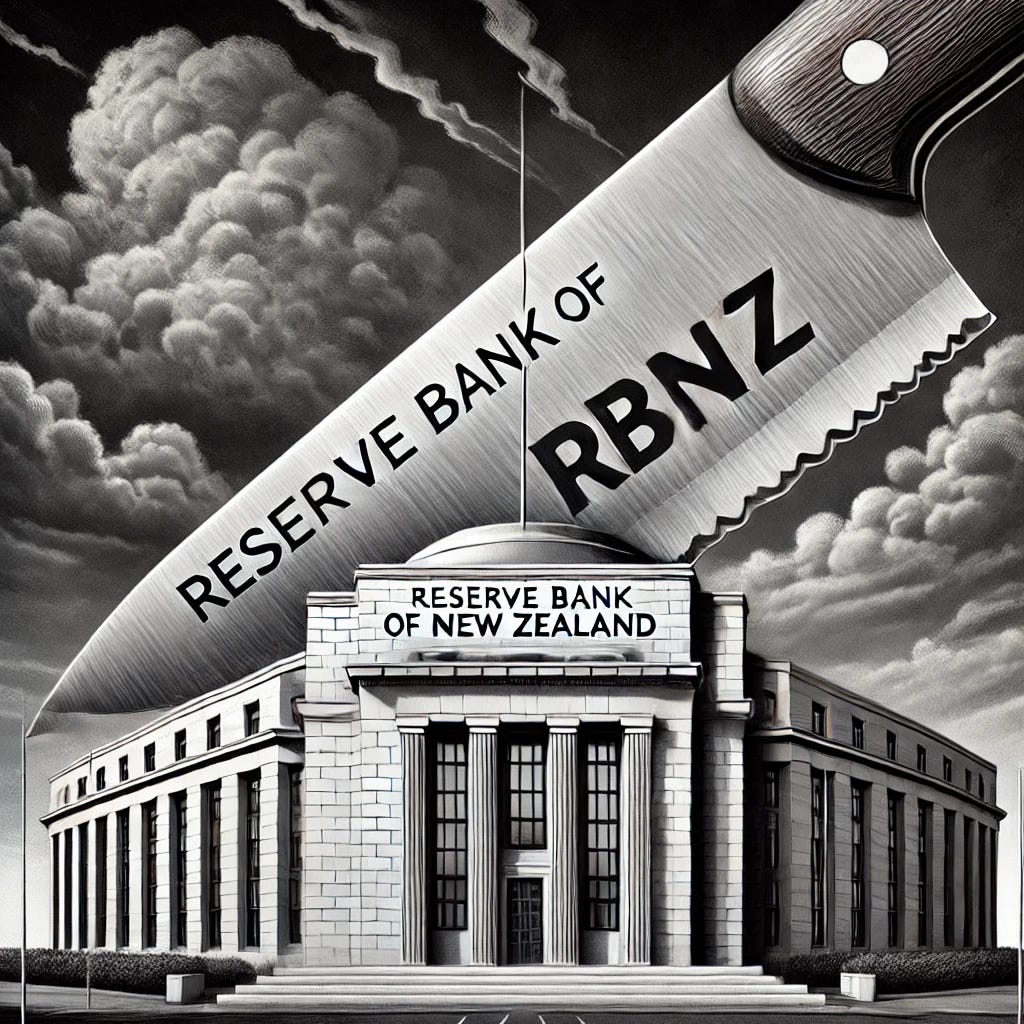
I am not saying that funding and scope are the reasons why Orr quit. And I’m not saying anything I’ve ever thought has made sense. I’m just saying that other people suggested it, and this would make a lot of sense as a reason for a dramatic exit.
Side note
In case any New Zealanders are listening I want to note one thing. I have seen A LOT of you talking about how we should be kind, and how Orr must be having a hard time to suddenly quit and not make an announcement. This article exemplifies this.
I’ll be straight with you - this is an incredibly embarrassing position and very wrong. It is not empathetic, it is protecting someone in power as they harm the New Zealand public.
Here we had the head of the RBNZ willing to walk out and generate massive uncertainty by not making any statement - there is no conceivable reason where this is a course of action that ensures the highest wellbeing of all New Zealanders. As a result, a person we trusted as the responsible person in the room - and gave great authority to - failed entirely in that duty.
When you are in a senior role you have a responsibility to lead. Even if you have to go because you feel disrespected, you put that to the side and you stand up for your service to all New Zealanders - you tell the public what has happened (or a censored version of it), and make sure that there isn’t global uncertainty that New Zealand is becoming a basket case.
You’re in the role because you care about the wellbeing of New Zealanders more than your own ego. I know its a hard standard that hardly any of us can reach - but that is what the $800k salary helps with.
There is a place in all our hearts where we want to believe that the Governor has had a struggle and we want to be empathetic about that. I get it, I feel that too - he must have had something that really hurt occur, and I don’t want him feeling that pain. But pain happens to all of us, and part of being the type of person we want to be - especially for a person that takes on great responsibility - is saying that you will do what you can to not harm others when protecting yourself from this pain.
Orr’s actions have harmed the credibility and strength of the New Zealand economy at a very difficult time for the whole country.
There is no excuse for this, and we should expect better from people in senior positions - be kind to those who lack power, but demand responsibility from those who have it. Allowing bad behaviour at the top is not being kind to those who lack social or political power, and by creating uncertainty it harms them.
And if no-one in New Zealand is willing to say this at the moment then damn something is really broken over there. What’s happened to Gareth Morgan calling all this type of stuff out for us?
Also surely there is no chance of a political career for Orr after this … we are not the United States the ability to act like an adult when facing stress is expected in Kiwi politicians. Hell my memory is that we expect it for teenage checkout operators.
Candidates
Do not trade on this information. These are the ill-formed personal views of someone who hasn’t lived in New Zealand for three years - and who has no strong relationships with anyone who knows anything. Reader discretion is advised.
Supposedly both the New Zealand Herald and Bloomberg have put up lists of candidates - but as I don’t subscribe I can only judge by the introduction.
Both expect the current deputies to be in the running - Christian Hawkesby and Karen Silk. I think this is extremely unlikely as that isn’t how New Zealand functions. As a country we don’t really do “promoting internally” - instead encouraging external entrants to come in.
And with a feeling that there is a desire to reevaluate certain structural elements of the Bank, an external candidate would be needed.
After chatting with some friends about this I realised I needed some external help - so I called on ChatGPT to give me the favourites.
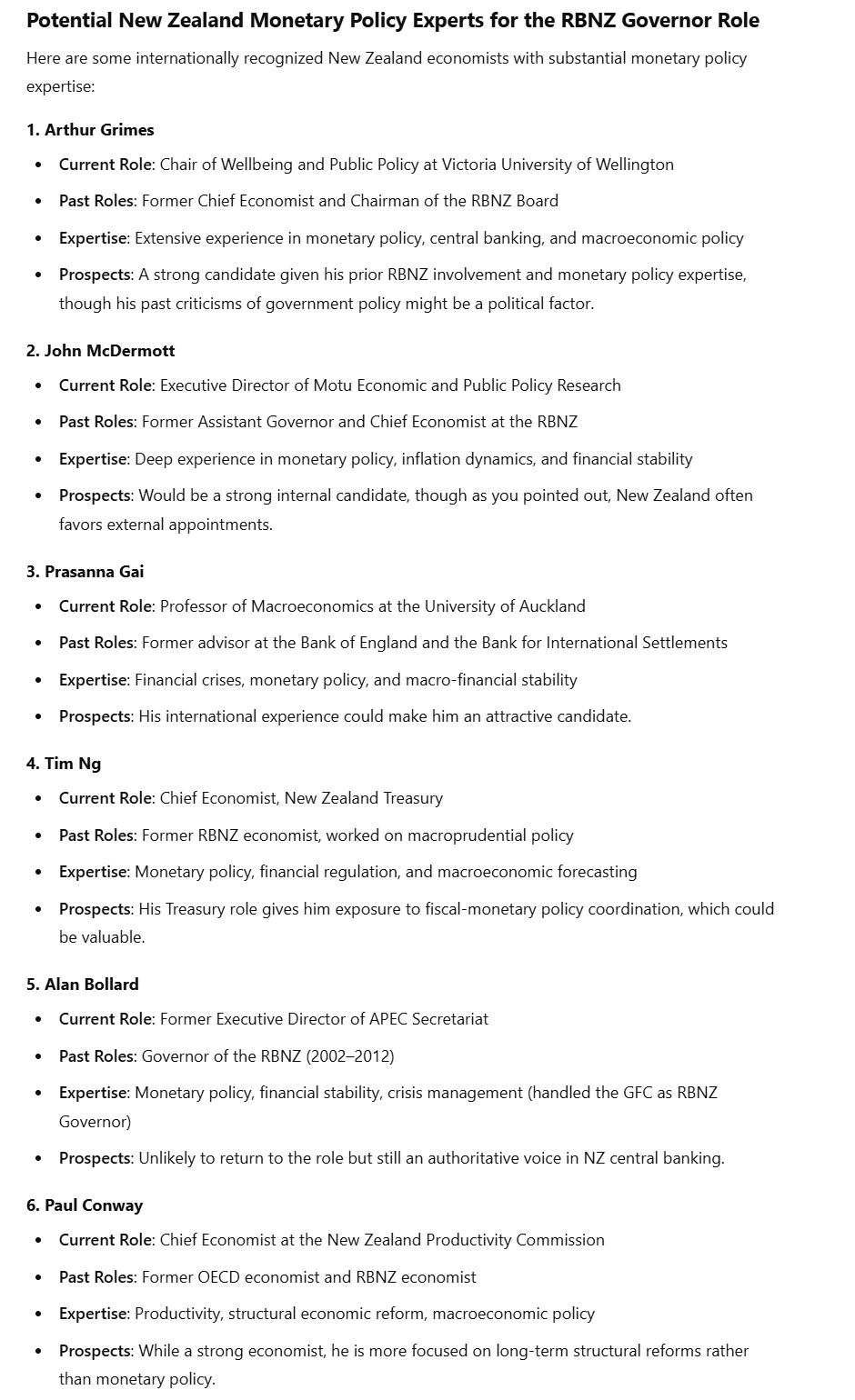
So a lot of this information is wrong/old - but the list is fun!
Lets have a dig. At number 6 we have Paul - who is actually now Chief Economist at the RBNZ. I like Paul and can see him in the role one day, but the “not internal” rule would knock him out right now.
Alan Bollard isn’t happening. The guy is a complete rockstar, but he’s already done his shift at the RBNZ.
Tim Ng at 4 is unlikely - he has stepped out of the Chief Economist role at Treasury to work on his PhD. We could switch this with the current Treasury Chief Economist Dominick Stephens - he will likely be in the running but I think it will be for the next term rather than this one.
So this gives us a top 3 - Arthur Grimes, John McDermott, and Prasanna Gai. Prasanna has recently joined the monetary policy committee so I suspect not. Leaving Arthur and John.
They would both be great, and I’m not going to litigate anything here because on a personal level I’d just be happy to see either of them in the role. But at this stage I think John is the more likely candidate - if only because, ChatGPT notes Arthur’s vocal critiques of RBNZ policy (which in my view is a healthy part of good decision making).
Then again, I have absolutely no knowledge or idea. As I say, both would be spectacular.
There are other potential candidates (dig around NZ twitter to see a bunch of good names suggested) - but I have no interest in dragging more names in. Especially since my personal preference is going to be Arthur or John above all of them - just from personal experience regarding their way of thinking and care about the mission of the RBNZ.